8
High
Pricing & Plans
Size availability gate
Product pages show a 'Get Notified' CTA for out-of-stock sizes, but the size selector is present, creating a potential expectation that all sizes are available when they are not.
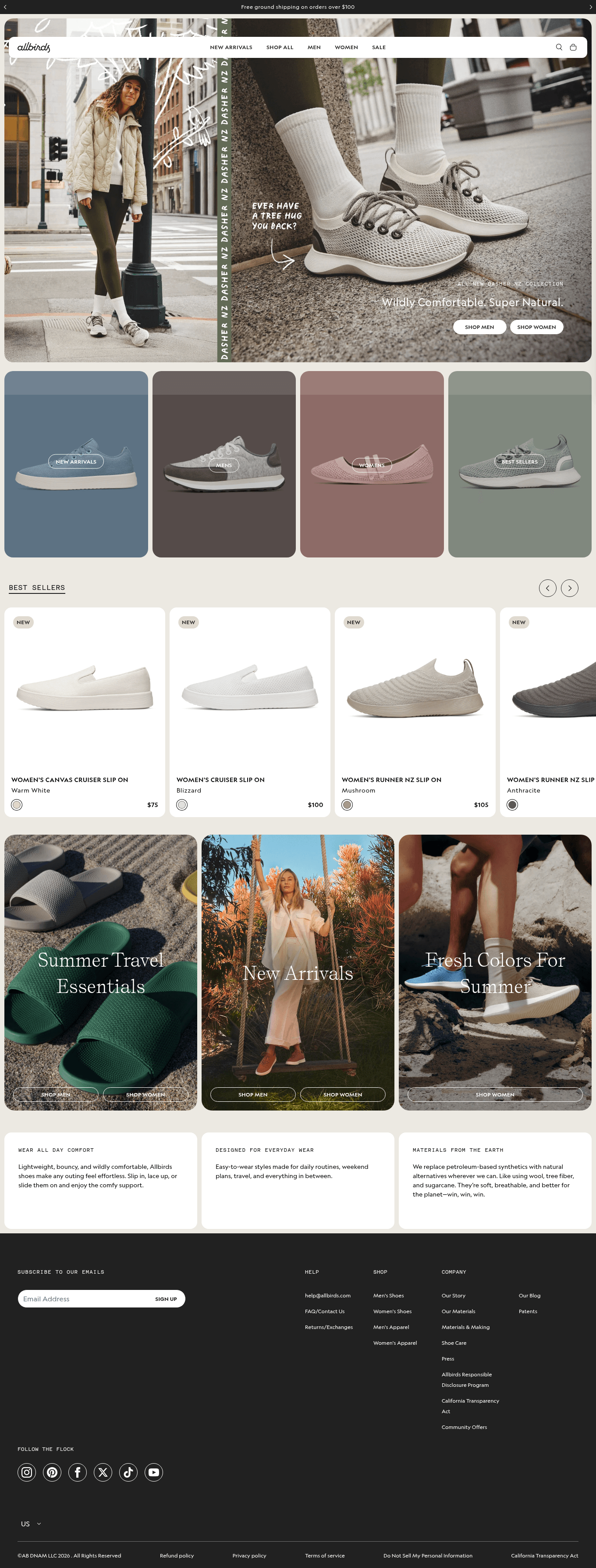
scroll ↕ — this is the live page
⚠ Size availability gateProduct pages show a 'Get Notified' CTA for out-of-stock sizes, but the size selector is present, creating a potential expectation that all sizes are …
Fix
Evidence
Observed on the live site
✓ Flagged independently by 1 of 7 analysts
- On /products/anytime-ankle-sock, the CTA 'Get Notified' appears, and the page has a size selector (direct_signals: size_selector: true). The body_sample includes 'Get Notified' but no explicit 'Out of Stock' messaging near the size selector.
Business case
If this change wins
$35,381 – $176,904
annual opportunity if it wins
Medium
Effort — 2-5 days
not testable at current traffic
A/B test duration
Prioritisation
PXL score: 4 / 10
| Question | Answer | Points |
|---|---|---|
| Is the change above the fold? | No | 0 |
| Is the change noticeable in under 5 seconds? | Yes | 2 |
| Does it add or remove an element? | Yes | 1 |
| Does it run on a high-traffic page? | Yes | 1 |
| Discovered via user testing? | No | 0 |
| Discovered via qualitative feedback (survey, support)? | No | 0 |
| Supported by heatmaps or session recordings? | No | 0 |
| Found via digital analytics or real-user field data? | No | 0 |
| Verified by direct technical measurement? | No | 0 |
Implementation
Hand this to your developer
- Surface
- Pricing & Plans — PRICING PAGE
- Problem
- Product pages show a 'Get Notified' CTA for out-of-stock sizes, but the size selector is present, creating a potential expectation that all sizes are available when they are not.
- Current state
- h1: Anytime Ankle Sock; cta: Get Notified; notes: Size selector present but some sizes may be unavailable, leading to 'Get Notified' instead of 'Add to Cart'.
- Change
- h1: Anytime Ankle Sock; cta: Add to Cart; notes: Clearly mark out-of-stock sizes with 'Out of Stock' and disable them, or show 'Get Notified' only for those sizes, to avoid confusion.
- Acceptance criteria
- GIVEN a first-time visitor on the affected page
WHEN the change is live
THEN Clearly mark out-of-stock sizes with 'Out of Stock' and disable them, or show 'Get Notified' only for those sizes, to avoid confusion, with no regression at 375px and 1280px widths. - Tracking
- event: cro_size_availability_gate on interaction with the changed element; verify it fires in BOTH variants before opening traffic.
- Success metric
- conversion rate on the affected step
- QA checklist
- Chrome / Safari / Firefox · 375px + 1280px · keyboard reachable · screen-reader name present · no CLS introduced
- Effort
- Medium — 2-5 days
- Test plan
- 299,882 visitors per variant (95% significance, 80% power); not testable at current traffic.
- Rollback
- Feature-flag the change; revert the flag if the primary metric drops for 3 consecutive days.