6
High
Navigation
Mega-Menu Choice Overload
The mega-menu presents 20+ items across multiple categories, risking choice overload and decision paralysis for users.
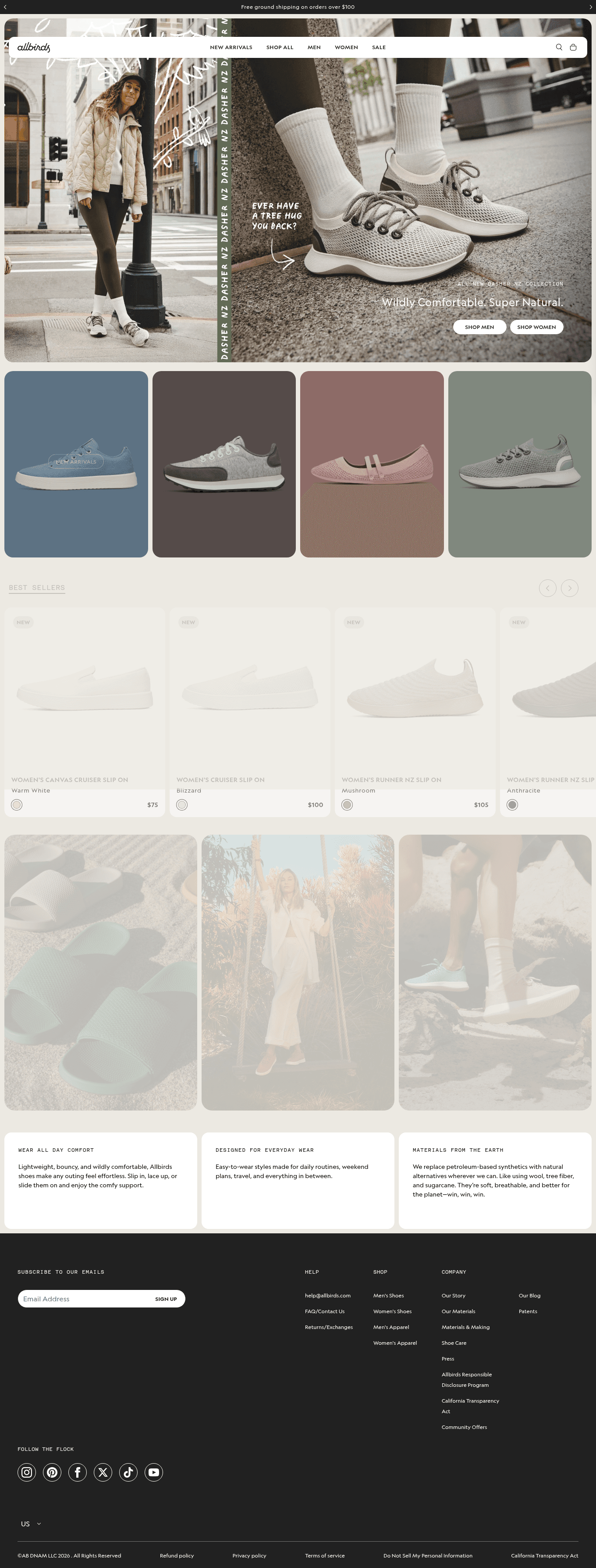
scroll ↕ — this is the live page
⚠ Mega-Menu Choice OverloadThe mega-menu presents over 20 items across multiple categories, overwhelming users with too many choices. This choice overload can lead to decision …
Reduce menu itemsRemove duplicatesClear hierarchySingle Shop All
Navigation
Wildly Comfortable. Super Natural.
Explore our collections
- New Arrivals
- Shop All
- Bestsellers
- Men's Shoes
- Women's Shoes
- Men's Apparel
- Women's Apparel
✓ Simplified menuReduced to 7 key items with clear hierarchy.
FixReduce the mega-menu to the top 5-7 items per category, focusing on the most popular and distinct categories. Remove duplicate entries and ensure a clear hierarchy with 'Shop All' as a single entry point. This simplification lowers cognitive load and helps users make quicker, more confident decisions. The streamlined menu also improves scanability, allowing users to find their desired category in under 5 seconds.
Evidence
Observed on the live site
✓ Flagged independently by 1 of 7 analysts
- nav_items list on homepage includes 20 items: 'New Arrivals', 'Shop All', 'Bestsellers', 'LEATHER ALTERNATIVES', 'Men's Shoes', 'Sneakers', 'Slip Ons', 'Sandals', 'Active', 'All-Weather', 'Runner NZ', 'Cruiser', 'Tree Runner NZ', 'Socks', 'Men's Apparel', 'Women's Shoes', 'Trainers', 'Flats', 'Canvas Cruiser', 'Women's Apparel'.
Business case
If this change wins
$35,381 – $176,904
annual opportunity if it wins
Medium
Effort — 2-5 days
not testable at current traffic
A/B test duration
Prioritisation
PXL score: 5 / 10
| Question | Answer | Points |
|---|---|---|
| Is the change above the fold? | Yes | 1 |
| Is the change noticeable in under 5 seconds? | Yes | 2 |
| Does it add or remove an element? | Yes | 1 |
| Does it run on a high-traffic page? | Yes | 1 |
| Discovered via user testing? | No | 0 |
| Discovered via qualitative feedback (survey, support)? | No | 0 |
| Supported by heatmaps or session recordings? | No | 0 |
| Found via digital analytics or real-user field data? | No | 0 |
| Verified by direct technical measurement? | No | 0 |
Implementation
Hand this to your developer
- Surface
- Navigation — NAV
- Problem
- The mega-menu presents 20+ items across multiple categories, risking choice overload and decision paralysis for users.
- Current state
- h1: Wildly Comfortable. Super Natural.; cta: SHOP MEN / SHOP WOMEN; notes: Mega-menu with 20+ items, multiple subcategories, and repeated patterns (e.g., 'New Arrivals' appears twice).
- Change
- h1: Wildly Comfortable. Super Natural.; cta: SHOP MEN / SHOP WOMEN; notes: Reduce mega-menu to top 5-7 items per category, use clear hierarchy, and avoid duplication. Consider a 'Shop All' as a single entry point.
- Acceptance criteria
- GIVEN a first-time visitor on the affected page
WHEN the change is live
THEN Reduce mega-menu to top 5-7 items per category, use clear hierarchy, and avoid duplication. Consider a 'Shop All' as a single entry point, with no regression at 375px and 1280px widths. - Tracking
- event: cro_mega_menu_choice_overload on interaction with the changed element; verify it fires in BOTH variants before opening traffic.
- Success metric
- conversion rate on the affected step
- QA checklist
- Chrome / Safari / Firefox · 375px + 1280px · keyboard reachable · screen-reader name present · no CLS introduced
- Effort
- Medium — 2-5 days
- Test plan
- 299,882 visitors per variant (95% significance, 80% power); not testable at current traffic.
- Rollback
- Feature-flag the change; revert the flag if the primary metric drops for 3 consecutive days.