1
Urgent
Product Page
Product Unavailability Block
A product page displays a price but offers a 'Get Notified' CTA instead of an 'Add to Cart' button, indicating unavailability without clear upfront communication.
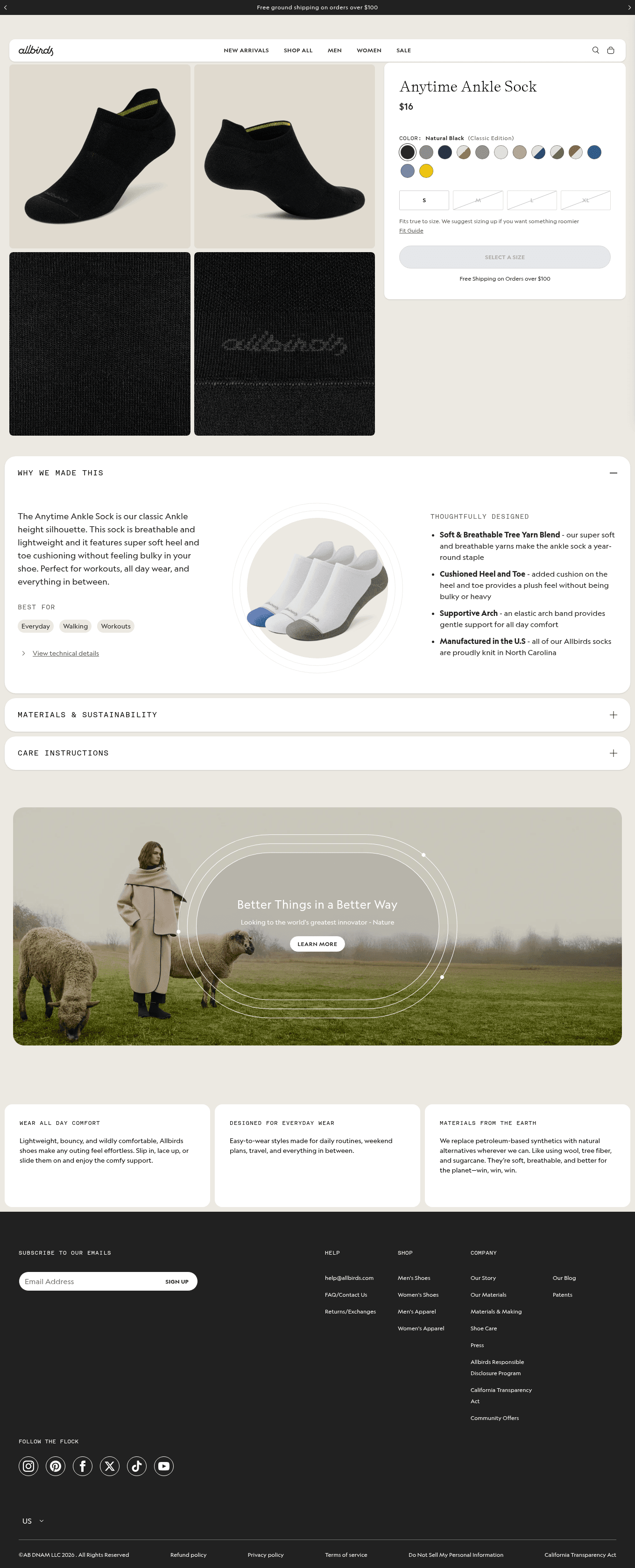
scroll ↕ — this is the live page
⚠ Product Unavailability BlockThe product page shows a price and a 'Get Notified' button, but no explicit stock status. Users see a purchasable-looking product with a price, yet …
Add stock statusSecondary CTAExplicit messaging
Product
Anytime Ankle Sock
$14.00
Color: White
Size: Medium
Quantity: 1
Get NotifiedFree shipping on orders over $50.
⚠ Out of StockThis item is currently unavailable. Join the waitlist to be notified when it's back.
✓ Clear Stock StatusAdd a clear 'Out of Stock' callout near the price and title, and change the primary CTA to a secondary 'Get Notified' button.
FixAdd a clear 'Out of Stock' callout near the price and title, and change the primary CTA to a secondary 'Get Notified' button. This sets accurate expectations and reduces frustration. If the product were available, the primary CTA would be 'Add to Cart', but in this case, the explicit status prevents wasted effort and builds trust.
Evidence
Observed on the live site
✓ Flagged independently by 1 of 7 analysts
- On '/products/anytime-ankle-sock', 'prices': ['$14.00'] is present, but 'ctas': ['Get Notified'] is offered, with no 'Add to Cart' CTA.
Business case
If this change wins
$70,762 – $283,046
annual opportunity if it wins
Medium
Effort — 2-5 days
40 days
A/B test duration
Prioritisation
PXL score: 5 / 10
| Question | Answer | Points |
|---|---|---|
| Is the change above the fold? | Yes | 1 |
| Is the change noticeable in under 5 seconds? | Yes | 2 |
| Does it add or remove an element? | Yes | 1 |
| Does it run on a high-traffic page? | Yes | 1 |
| Discovered via user testing? | No | 0 |
| Discovered via qualitative feedback (survey, support)? | No | 0 |
| Supported by heatmaps or session recordings? | No | 0 |
| Found via digital analytics or real-user field data? | No | 0 |
| Verified by direct technical measurement? | No | 0 |
Implementation
Hand this to your developer
- Surface
- Product Page — PRODUCT PAGE
- Problem
- A product page displays a price but offers a 'Get Notified' CTA instead of an 'Add to Cart' button, indicating unavailability without clear upfront communication.
- Current state
- h1: Anytime Ankle Sock; cta: Get Notified; notes: The product page for 'Anytime Ankle Sock' shows a price of $14.00 but only offers a 'Get Notified' button, implying the product is out of stock or not yet released, without explicitly stating its status.
- Change
- h1: Anytime Ankle Sock; cta: Add to Cart (if available) / Out of Stock (if unavailable); notes: If the product is unavailable, clearly state 'Out of Stock' or 'Coming Soon' near the product title/price. If it's available, ensure an 'Add to Cart' CTA is present. Avoid leading users to a product page where they cannot complete a purchase without clear upfront messaging.
- Acceptance criteria
- GIVEN a first-time visitor on the affected page
WHEN the change is live
THEN If the product is unavailable, clearly state 'Out of Stock' or 'Coming Soon' near the product title/price. If it's available, ensure an 'Add to Cart' CTA is present. Avoid leading users to a product page where they cannot complete a purchase without clear upfront messaging, with no regression at 375px and 1280px widths. - Tracking
- event: cro_product_unavailability_block on interaction with the changed element; verify it fires in BOTH variants before opening traffic.
- Success metric
- conversion rate
- QA checklist
- Chrome / Safari / Firefox · 375px + 1280px · keyboard reachable · screen-reader name present · no CLS introduced
- Effort
- Medium — 2-5 days
- Test plan
- 118,817 visitors per variant (95% significance, 80% power); 40 days.
- Rollback
- Feature-flag the change; revert the flag if the primary metric drops for 3 consecutive days.